
PCR FIBC Bags: Understanding Post-Consumer Recycled Content
Global supply chains are rapidly shifting toward circularity. As a result, PCR FIBC bags offer a practical way to cut virgin plastic use in heavy-duty packaging. Below, explore how post-consumer recycled polypropylene works, why verified PCR content matters, and what new regulations mean for buyers.
What Are PCR FIBC Bags?
PCR FIBC Bags are Flexible Intermediate Bulk Containers often called Jumbo Bags or Bulk Bags. Manufacturers produce these bags from polypropylene (PP) resin blended with Post-Consumer Recycled (PCR) material.
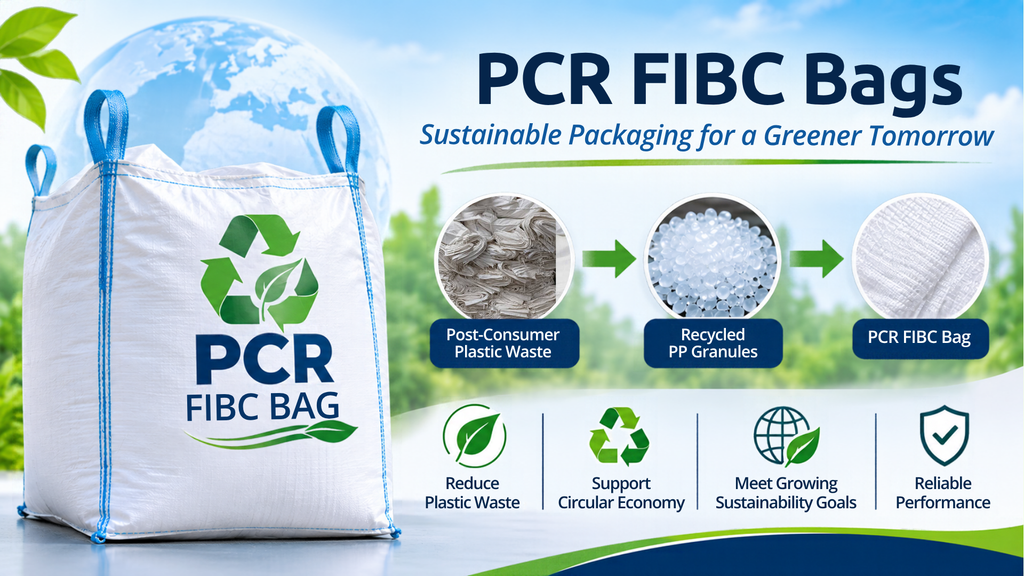
Unlike virgin plastics from fossil feedstocks, PCR comes from used household, commercial, or industrial packaging. First, recycling facilities collect, sort, and clean this post-use plastic. Next, they reprocess the material into recycled PP granules. Manufacturers then blend these granules with virgin polypropylene to weave strong FIBC fabrics.
How Manufacturers Calculate Recycled Content
For example, an FIBC bag with 30% PCR material and 70% virgin PP integrates recycled directly into its fabric. However, the exact recycled-content percentage varies by design. Applicable calculation rules determine the final figure by specifying which bag components—such as body fabric, lifting loops, or liners—count toward the total.
Why Is PCR Important in FIBC Packaging?
Adding post-consumer recycled polypropylene to bulk bags supports both sustainability goals and strict procurement standards. Specifically, PCR delivers four major advantages:
- Reduced Virgin Plastic Use: Blending PCR resin into woven PP tapes directly lowers the demand for newly produced virgin polypropylene.
- Plastic Waste Recovery: Furthermore, using PCR drives post-use plastic collection and sorting. This process diverts durable polymers away from landfills.
- Advancing the Circular Economy: In addition, reintroducing recovered polypropylene into industrial bulk bags keeps valuable plastic resources in active use.
- Meeting Buyer Expectations: Meanwhile, global distributors and buyers increasingly evaluate suppliers on verifiable sustainability metrics and recycled-content options.
Understanding PCR Percentage in FIBC Bags
The PCR percentage shows the share of qualifying post-consumer recycled polymer inside the bag’s total plastic weight. Because recycled resins behave differently during extrusion than virgin polymers, engineers carefully calibrate blend ratios. Consequently, the woven tape retains consistent tensile strength.
Example: 30% PCR Content Breakdown
The table below shows a simplified weight breakdown for a standard 2 kg FIBC bag with 30% PCR content:
| Material Component | Share (%) | Weight (kg) |
|---|---|---|
| Virgin Polypropylene (PP) | 70% | 1.4 kg |
| Post-Consumer Recycled (PCR) PP | 30% | 0.6 kg |
| Total Plastic Content | 100% | 2.0 kg |
Note: This table shows a simplified weight-based calculation. Official regulatory frameworks often apply specific rules regarding which packaging components count.
Technical Considerations for PCR FIBC Bags
Recycled polypropylene undergoes extra thermal processing before reaching the weaving loom. Therefore, polymer chains experience a higher heat history. To ensure PCR FIBC bags perform safely, manufacturers test six critical benchmarks:
Mechanical Strength & Durability
- Tensile Strength & Elongation: Woven PP tapes with PCR must meet strict mechanical strength specs. Thus, the fabric resists tearing under heavy loads.
- UV Resistance: Outdoor storage and long-haul transit expose bags to sunlight. Because recycled resins degrade faster under UV rays, manufacturers add tailored UV stabilizers.
- Stitching & Seam Performance: Quality teams test thread selection and seam construction. As a result, lifting loops and side seams hold securely under dynamic stress.
- Safe Working Load (SWL): Finished bulk bags must safely support their rated capacity, which typically ranges from 500 kg to 2,000 kg.
- Safety Factor (5:1 and 6:1): Labs validate required 5:1 or 6:1 safety factors through top-lift testing.
- Material Traceability: Finally, transparent resin sourcing records and batch documents must back every recycled-content claim.
PCR FIBC Bags and European PPWR Requirements
New regulations are rapidly accelerating recycled-content adoption across industrial packaging. In Europe, the Packaging and Packaging Waste Regulation (PPWR)—Regulation (EU) 2025/40—sets mandatory minimum recycled-content targets for plastic packaging.
EU Recycled Content Targets (2030 & 2040)
Under Article 7 of the EU PPWR, general (“other”) plastic packaging categories face strict minimum targets:
- By 2030: Packaging must contain at least 35% post-consumer recycled content.
- By 2040: That minimum requirement rises to 65% recycled content.
(Note: Contact-sensitive packaging categories, such as food or pharmaceutical bags, follow different target thresholds and exemptions.)
How Plant-Level Averaging Works
For FIBC manufacturers and importers, the exact target depends on packaging classification and intended use. Importantly, the PPWR calculates these targets as an average per manufacturing plant and year for each packaging format. Therefore, regulators do not require an identical PCR percentage inside every single bag.
Official Reference: Regulation (EU) 2025/40 – Packaging and Packaging Waste Regulation (EUR-Lex)
Frequently Asked Questions About PCR FIBC Bags
What does PCR mean in FIBC bags?
PCR stands for Post-Consumer Recycled content. In FIBC manufacturing, it refers to polypropylene recovered from used products, cleaned, pelletized, and blended with virgin PP to weave bulk bag fabric.
Are PCR FIBC bags as strong as virgin PP bulk bags?
Yes, for non-food and non-hazardous industrial uses. When manufacturers use high-grade recycled resin and pass tensile, UV, and seam tests, PCR FIBC bags reliably achieve standard 5:1 and 6:1 safety factors.
What are the EU PPWR recycled content targets for FIBC bags?
Under Article 7 of EU Regulation 2025/40 (PPWR), general plastic packaging must meet a 35% target by 2030 and a 65% target by 2040. Regulators calculate these percentages as an annual average per manufacturing plant.
Moving Toward Sustainable Bulk Packaging
Understanding PCR materials, mechanical testing, and regulations like the EU PPWR helps buyers modernize bulk packaging procurement. With disciplined resin selection and strict testing, PCR FIBC bags cut virgin plastic use without sacrificing warehouse safety.
Ready to explore PCR FIBC solutions for your supply chain?
Contact the FIBC Silvassa team today to discuss custom PCR blend ratios, request technical datasheets, or review testing specs.